Choosing the Right Tools for Your Startup
Every founder wants to ship their product quickly. However, choosing the wrong tech stack early on creates massive technical debt. You will spend months rewriting code instead of releasing features. Let's evaluate Laravel, Node.js, and Next.js from a startup roadmap perspective.
Laravel: The Solo Founder's Superpower
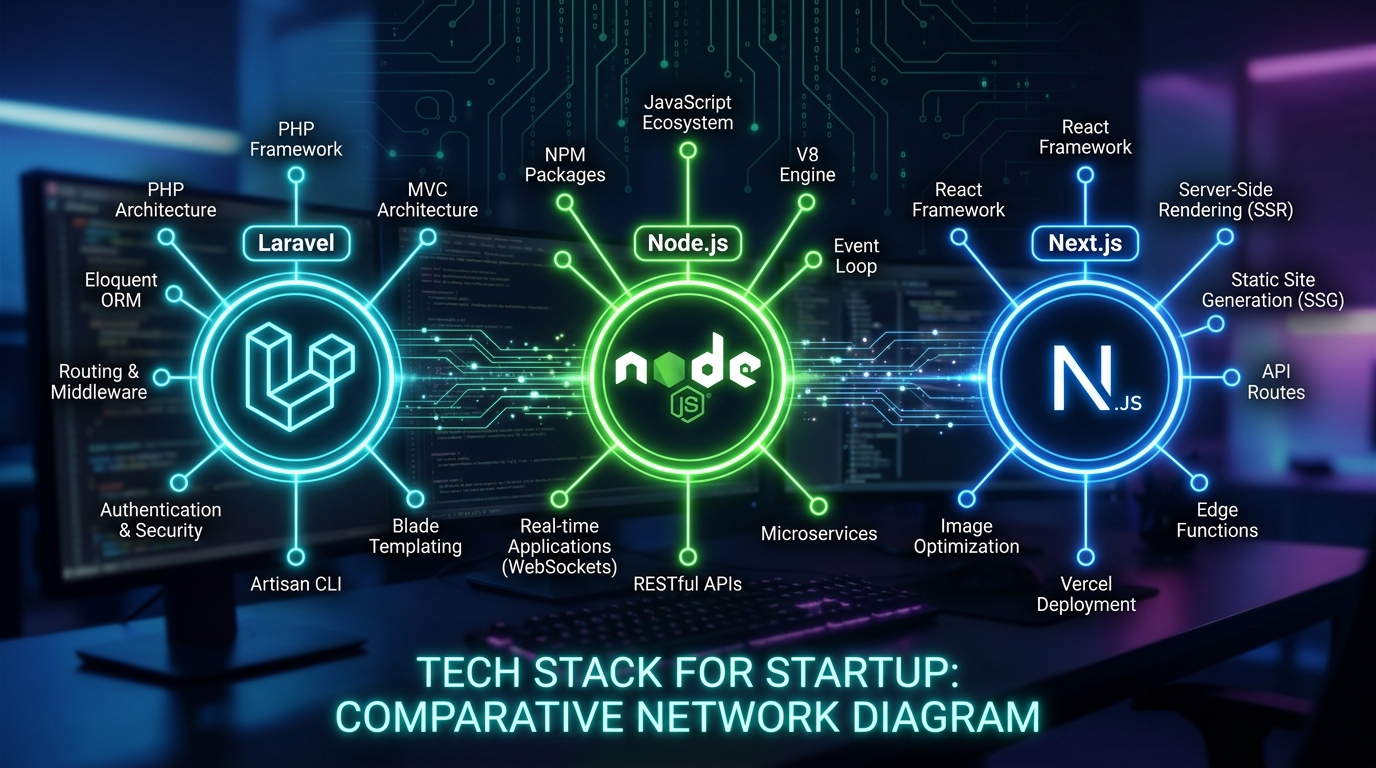
Laravel is a PHP framework built for rapid development. It comes with built-in authentication, database ORM (Eloquent), queues, mail templates, routing, and billing scripts (Laravel Cashier) out-of-the-box.
Pros: Insane development speed, secure defaults, highly structured.
Cons: PHP is often perceived as older tech (though PHP 8.2+ is incredibly fast).
Best for: SaaS products, MVPs, transactional web portals, and CRUD apps where structural stability is crucial.
Next.js: The Front-End Masterpiece
Next.js is a React framework specializing in server-side rendering (SSR) and static site generation (SSG). It delivers insanely fast page loads and perfect SEO structures.
Pros: Stunning client visual transitions, hybrid rendering models, seamless API routing.
Cons: Node backend logic is not as comprehensive out-of-the-box as Laravel (needs separate libraries for queues, database, auth).
Best for: SEO-driven web portals, interactive consumer products, SaaS landing pages, and content dashboards.
Node.js (Express/NestJS): The Scalable API Hub
Node.js runs Javascript on the server, making it highly concurrent and optimal for handling thousands of requests simultaneously.
Pros: High scalability, unified Javascript language stack (same language front and back).
Cons: Express is unopinionated, meaning developers have to set up routing, databases, and structural architectures manually.
Best for: Microservices, real-time messaging, IoT servers, and lightweight API backends.